
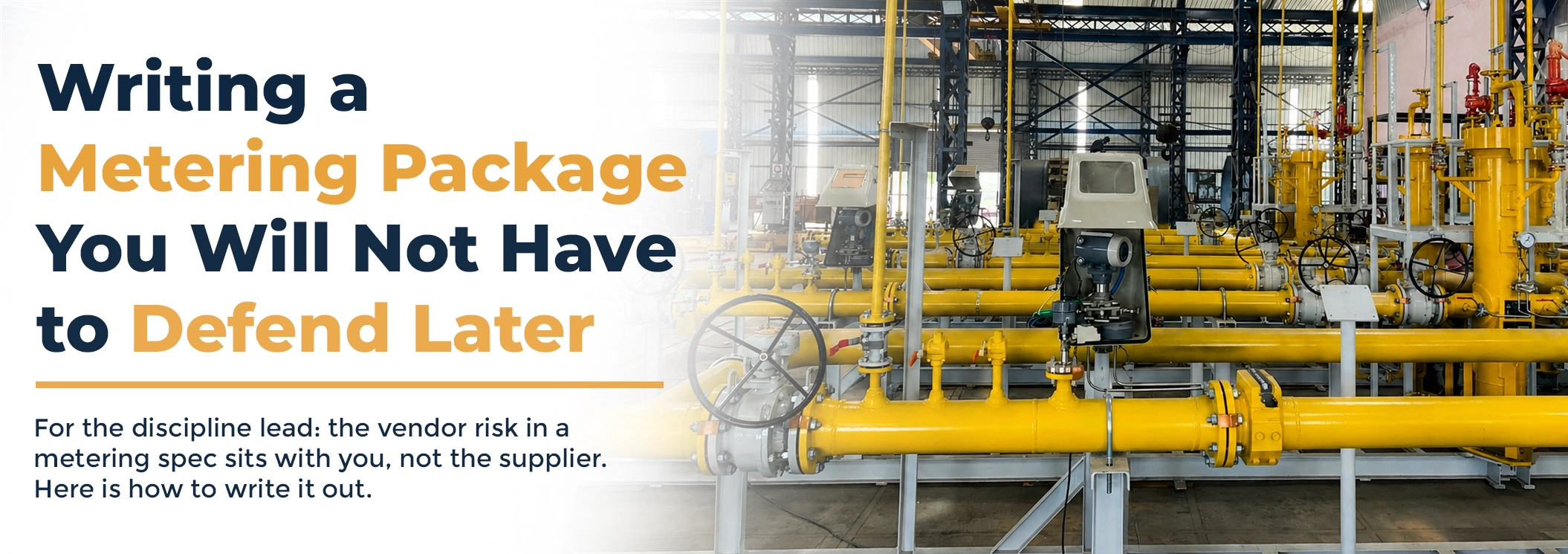
When a process or instrumentation discipline writes a metering package into a refinery or pipeline specification, the exposure is subtle. The question is rarely whether the meter can measure — it is whether the eventual supplier can deliver to the datasheet, document to PSU standards, and not become the package that slips the schedule. That risk lands on the discipline that specified it. A specification written with that in mind is a quieter project later.
Build-to-spec means the datasheet leads
There is a real difference between a vendor who builds to your datasheet and one who fits your requirement to a fixed catalogue. A metering package engineered to ISO 5167, the applicable AGA reports and API MPMS against your actual process data and P&ID will behave as specified across the operating envelope. One reverse-fitted from a standard product tends to meet the headline accuracy at the design point and quietly degrade at the turndown extremes the datasheet also called for. Writing the specification so it demands the former is most of the battle.
Make the uncertainty budget a deliverable
An accuracy class is a marketing number; an uncertainty budget is an engineering one. A specification that asks for a stated overall measurement uncertainty at defined operating points — computed to ISO 5168 / GUM principles, with the contribution of each element visible — forces the supplier to prove the number rather than assert it. It also gives the eventual reviewer something to check against instead of a class stamp. This single requirement filters vendors more effectively than any qualification clause.
Local content, written so it does not exclude capability
Make-in-India and public-procurement local-content provisions increasingly appear in PSU specifications, and they can be written two ways: as a box that a genuinely capable local manufacturer with global measurement technology can satisfy, or as wording that accidentally screens out exactly that. The distinction is worth getting right at the specification stage, because it is far harder to fix at tender. A vendor already pre-qualified and documented against third-party-inspection expectations is one less variable when the package finally moves.
Talk to an EMPL Measurement Engineer
Two low-commitment ways to start: a 30-minute lunch-and-learn with your instrumentation discipline on custody and flare metering assurance, or a vendor-registration pack so EMPL is on your approved list for the next package. Either is useful; neither obligates anything.


© 2026 EXIMP
Design Made by Eximp Measurement Private Limited

