
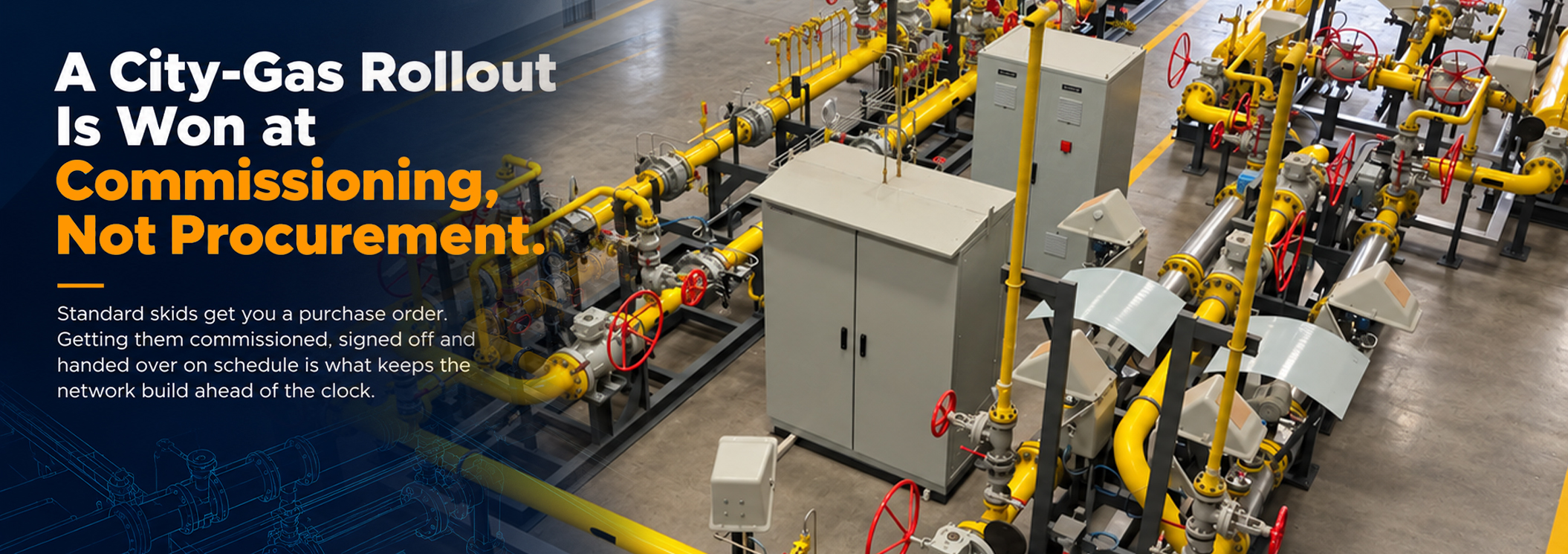
Choosing a standard metering skid is the easy part of a city-gas rollout. The hard part comes later — at commissioning, statutory sign-off and handover, dozens of times over, against a minimum-work-programme deadline. A station sitting idle for a pending PESO approval, a missing calibration certificate or an incomplete document set is a station not flowing gas, and the network build slips one skid at a time.
Fabrication that runs to a rollout plan
A standardised CGS / DRS / MRS package is worth most when it turns fabrication into a production line rather than a series of bespoke jobs. Identical drawings and bills of material let build run in parallel and ship to a rollout schedule — ideally ready ahead of civil readiness, not chasing it. The point of standardising was never elegance; it was throughput.
Commissioning and statutory sign-off, first time
A station flows gas only after it is purged and pre-commissioned to OISD practice and cleared under the PESO / SMPV rules. Both go faster when the package was built to a design already proven through that approval, with calibration certificates and test records assembled before the inspector arrives rather than chased afterward. The station that clears inspection first time is the one that keeps the rollout on schedule.
Handover the O&M team can actually run
A network is built once and operated for decades. A skid handed over with as-builts, calibration traceability and an O&M manual its operators can use is a maintainable asset; one handed over as a box of undocumented hardware becomes a liability the moment it needs service. Handover discipline is part of the delivery, not an afterthought to it.
Talk to an EMPL measurement engineer
Send us your remaining geographical areas and station schedule, and we will show you the standard CGD metering package and how we deliver it to a rollout plan — fabrication through commissioning to handover. Request the package or a demo.

© 2026 EXIMP
Design Made by Eximp Measurement Private Limited

