
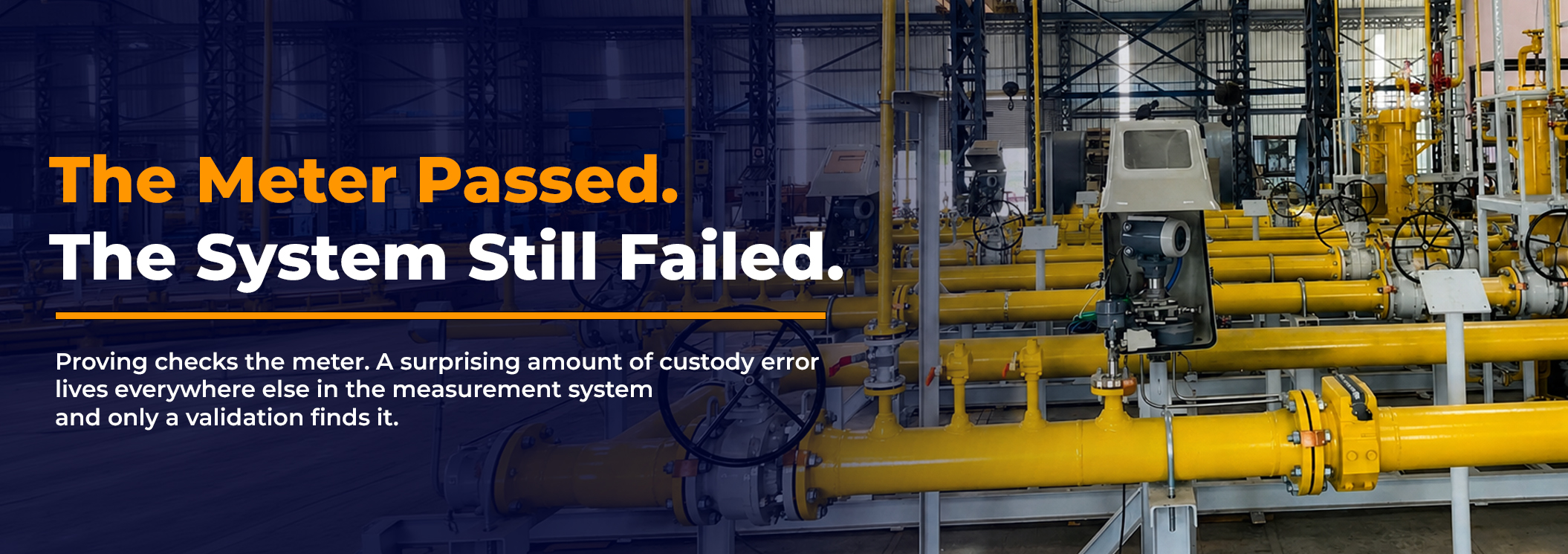
When a custody number is challenged, the first instinct is to prove the meter. Often the meter is fine. The error is somewhere else in the measurement system — in the flow computer’s configuration, an out-of-calibration transmitter, an unrepresentative gas sample — and no amount of proving the primary element will find it. A meter can be perfectly accurate and the reported volume still wrong.
Proving answers one question: is the primary meter reading true? A custody figure depends on a dozen more.
The flow computer is where quiet errors live
A modern custody station computes flow in an electronic flow computer to API MPMS Chapter 21, combining the primary measurement with pressure, temperature and composition. It is also where a single wrong constant biases every calculation that follows — a transposed K-factor, a base condition set wrong, an AGA 8 composition left stale after the gas changed. These errors do not alarm. They compute cleanly and wrongly, month after month, until someone reconciles.
Secondary instruments drift on their own schedule
The pressure and temperature transmitters feeding the gas calculation have their own calibration lives. An out-of-calibration pressure transmitter skews the entire corrected volume, and unlike the meter it rarely gets proved. Calibration currency and traceability on the secondary instruments is not paperwork — on a custody stream it is part of the number.
The number is only as good as the sample
A gas custody figure is computed from a composition, and the composition comes from a sample. If the sampling system — probe, conditioning, timing — does not deliver a representative sample per API MPMS Chapter 14.1, the energy assigned to every unit of gas is biased in a way no meter can correct. Sampling is the least glamorous part of a metering station and one of the most common sources of dispute.
Validation is a periodic system audit, not a one-off
This is why measurement validation is a discipline in its own right, distinct from proving. Along the lines of a measurement-management system (ISO 10012), it periodically audits the whole chain — primary element, flow computer configuration, secondary calibration, sampling and uncertainty budget — and confirms the reported number can be defended end to end. It is the check between provings that catches what routine operation misses.
Talk to an EMPL measurement engineer
A site measurement-assurance review does exactly this: an EMPL engineer validates the full custody stream — not just the meter — and returns a findings report you can act on. Worth booking if a number has been questioned, or before one is.


© 2026 EXIMP
Design Made by Eximp Measurement Private Limited

