
At a custody transfer point, failure is quiet. The loss-gain statement widens by a tenth of a percent, a counterparty starts asking pointed questions, and by the time the meter station is opened the disputed volume is already months deep. Three things decide whether the number holds up when it is finally challenged, and none of them is the meter’s brochure accuracy.
Calibration is a moment; proving is a habit
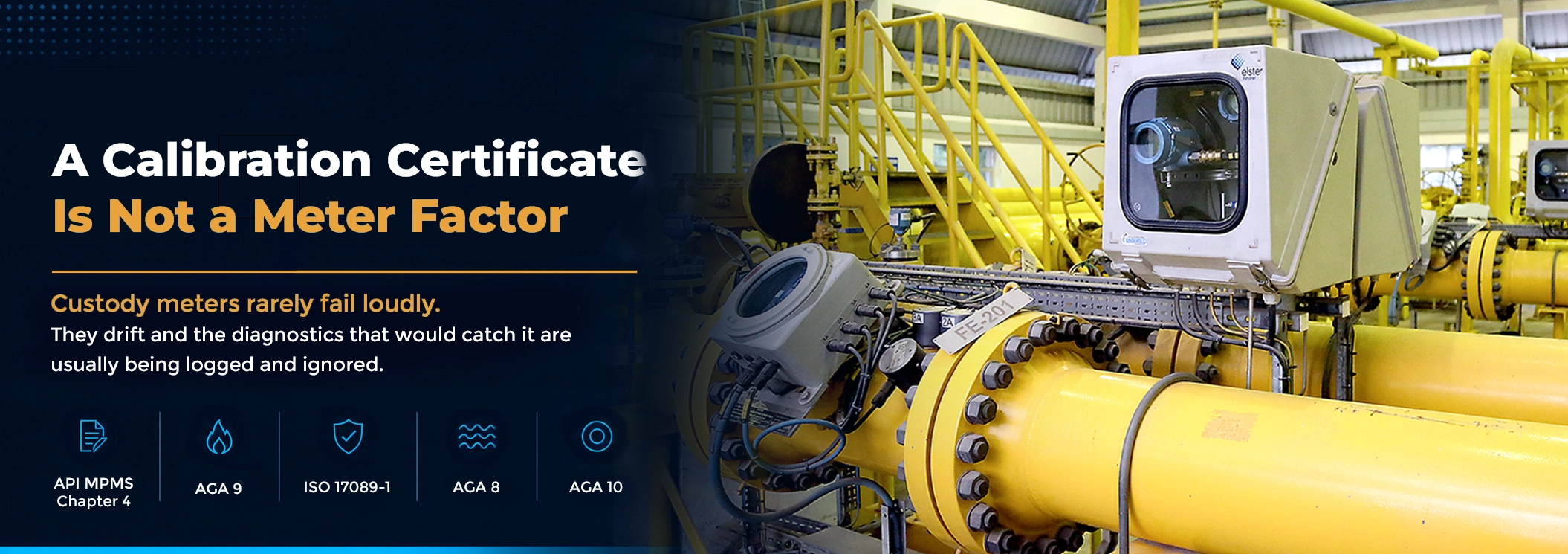
A calibration certificate records how a meter behaved on a bench, once, under reference conditions. It is not the meter factor the meter carries in service today. Only proving — comparing the meter against a reference under actual operating conditions, per API MPMS Chapter 4 — produces a defensible, trended meter factor. A small volume prover, a bidirectional prover or a master meter each has its place; what matters is that the meter factor is measured, trended and owned, not assumed from commissioning. On liquid crude custody, the gap between a proved factor and an assumed one is real money on every parcel.
The diagnostics you are already paying for
A gas ultrasonic meter under AGA Report No. 9 and ISO 17089-1 is not a black box that outputs a flow rate. It reports per-path velocities, individual transducer gains, signal-to-noise ratios, a measured speed of sound, turbulence and a velocity profile. Most stations log all of it and no one looks until there is a dispute. Yet the single most powerful health check costs nothing: compare the meter’s measured speed of sound against the value calculated from gas composition using AGA 8 and AGA 10. A meaningful divergence points to a fouled transducer, a composition error or a genuine drift — and it shows up long before the loss-gain does.
The meter was fine—the pipe changed
A meter that met its uncertainty at factory acceptance can sit outside it in the field if the installation no longer matches the qualification. New tap-off skids, sectionalising valve stations and intermediate-pigging metering added to an ageing line change the upstream velocity profile. AGA 9’s straight-length and flow-conditioning provisions exist for exactly this reason. After any tie-in, the honest question is not “does the meter work” but “is the meter still installed the way it was proved”. Those are different questions with different answers.
Talk to an EMPL Measurement Engineer
A proving and validation consult is deliberately narrow: an EMPL engineer reviews your custody points — proving records, ultrasonic diagnostic logs, uncertainty budget — and hands back a prioritised assurance report. Nothing gets replaced to have the conversation.


© 2026 EXIMP
Design Made by Eximp Measurement Private Limited

