
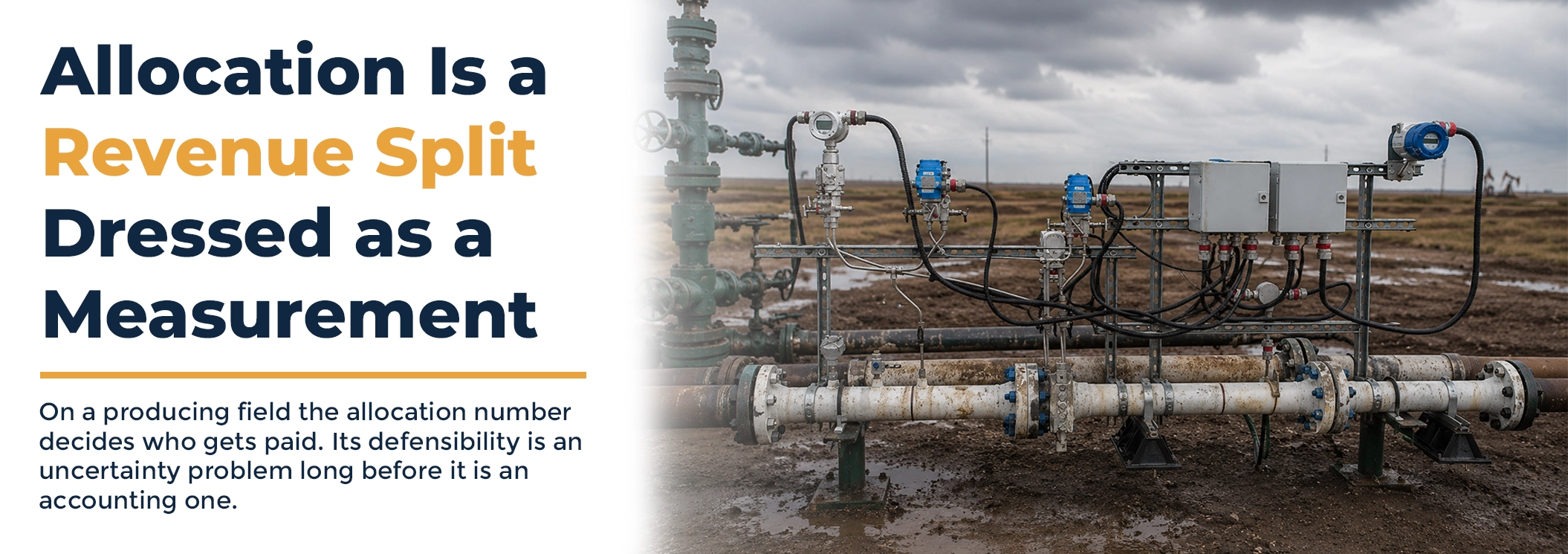
Allocation looks like an engineering detail and behaves like a commercial contract. It determines how production — and therefore revenue, cost and the government’s share — is split between partners and wells. As long as the field is stable, a rough allocation survives unchallenged. Introduce a new well-head platform, an enhanced-recovery flood or a subsea tie-in, and the production mix shifts; the uncertainty that was always there becomes visible, and it becomes visible in a partner meeting.
Uncertainty does not disappear — it moves
Most allocation schemes measure some streams and derive others by difference. That structure has a consequence the API MPMS Chapter 20 framework makes explicit: the uncertainty of every metered stream propagates into the allocated result, and the stream computed by difference inherits the sum of everyone else’s error. A station uncertainty that is tolerable on its own can translate into a materially disputed barrel once it is run through the allocation. Knowing where the uncertainty concentrates is the first honest step; it is rarely where the attention is.
A test separator that no longer describes the well
Per-well allocation usually rests on periodic well testing. A test separator sized and tuned for first oil steadily loses its grip on a maturing well as water cut climbs and gas breaks out of solution. The test still produces numbers; they simply describe a well that no longer exists. Where the economics justify it, multiphase measurement removes the separator’s limitations entirely — but the prior question is whether the existing well-test regime still resolves what the field is actually doing. Often it does not, and the allocation has been quietly inheriting that error.
Wet gas, and the streams you inject
A gas-condensate or associated-gas stream carrying liquid over-reads when it is metered as if it were dry. ISO/TR 11583 quantifies the over-reading and the correction; ignoring it biases the fiscal number at the plant inlet in a direction that is predictable but unmeasured. At the other end of the field, enhanced-recovery only works if what goes down each injector is dosed and metered — ASP chemical injection and steam injection are measurement disciplines in their own right, and an unmetered flood is an expensive act of faith.
Talk to an EMPL Measurement Engineer
This is an account-based conversation, not a mailshot. We would value a technical discussion on your field’s allocation architecture — where the uncertainty sits, and what it would take to make the number defensible at the JV table. No proposal attached.


© 2026 EXIMP
Design Made by Eximp Measurement Private Limited

